
Table of Contents
Planning to launch an online store in 2027? One of the first questions you're likely to ask is: How much does a Shopify website actually cost?
At first glance, the answer seems simple.
Shopify offers monthly subscription plans, free website themes and built-in ecommerce tools that make it possible to launch an online store without extensive technical knowledge.
However, a Shopify subscription is only one part of the total cost.
A business launching a basic online store using a free theme will have very different expenses from an established brand investing in a custom Shopify website, advanced product functionality and digital marketing.
The total investment may include website design, development, product uploads, domain registration, third-party applications, payment processing, marketing and ongoing maintenance.
For businesses migrating from WooCommerce, Wix, Magento or another platform, additional expenses may also arise from data migration, integration requirements and SEO preservation.
This makes it important to understand the difference between paying for Shopify and investing in a complete ecommerce website.
In this guide, we'll explain the current Shopify pricing structure, examine the major expenses involved in building a store and provide practical budgeting examples for 2027.
We'll also compare different development approaches, highlight costs businesses often overlook and explain how to choose an investment level appropriate for your goals.
Whether you're launching your first ecommerce business or planning a more advanced Shopify storefront, this guide will help you make an informed decision.
Note: As of 2026, Shopify has not established a guaranteed pricing schedule for the whole of 2027. The official subscription figures in this article are current published prices. Development budgets are illustrative planning estimates, not fixed market rates or quotations from Basiltech Solutions.
How Much Does a Shopify Website Cost in 2027?
The cost of a Shopify website depends primarily on how you build it and what functionality your business requires.
A do-it-yourself store can begin with the platform subscription, a domain and a free theme.
A professionally designed ecommerce website requires additional investment in design, development and implementation.
Larger businesses may need custom applications, integrations, advanced workflows or Shopify Plus.
Quick Shopify Website Cost Overview
The following figures are illustrative USD planning ranges for 2027, not guaranteed provider quotations or verified market averages.
| Shopify Website Type | Illustrative One-Time Build Budget | Suitable For |
|---|---|---|
| DIY Shopify Store | $0–$500 in purchased setup assets | Entrepreneurs using built-in tools |
| Basic Professional Setup | $1,500–$5,000 | Small businesses needing store configuration |
| Customized Shopify Store | $5,000–$15,000 | Growing brands seeking stronger UX and customization |
| Fully Custom Shopify Website | $15,000–$50,000+ | Established ecommerce businesses |
| Complex Shopify Plus Project | $30,000–$100,000+ | Enterprise or integration-heavy businesses |
These ranges exclude ongoing Shopify subscriptions, payment processing, advertising, inventory and other operating costs unless specifically included in a project budget.
They are intended to illustrate how project scope changes expenditure. A simpler or more complex project may fall outside these ranges.
What Makes One Shopify Website More Expensive Than Another?
Consider two businesses.
The first sells 20 handmade products and needs a basic storefront, product pages and checkout.
The second sells 5,000 products across several countries, manages multiple warehouses and requires integration with an ERP system.
Both businesses may use Shopify.
However, their design, development, data and integration requirements are completely different.
This is why comparing Shopify website quotes based solely on price can be misleading.
A useful quote explains precisely what the business receives.
Shopify Subscription Plans and Pricing
Before calculating development expenses, it's important to understand Shopify's platform fees.
Shopify offers different subscription tiers based on operational requirements, business complexity and access to advanced features.
Current Shopify Pricing in USD
The following prices reflect Shopify's published US pricing as checked in 2026.
| Shopify Plan | Monthly Billing | Monthly Equivalent With Annual Billing | Annual Subscription at Annual Rate |
|---|---|---|---|
| Basic | $39 | $29 | $348 |
| Grow | $105 | $79 | $948 |
| Advanced | $399 | $299 | $3,588 |
| Shopify Plus — 1-Year Term | $2,500/month | Not applicable | $30,000 |
| Shopify Plus — 3-Year Term | $2,300/month | Not applicable | $27,600 annualized |
For Shopify Plus, the $2,300 monthly rate requires a three-year contractual term. That represents $82,800 across 36 months before additional charges, assuming the quoted fixed rate applies throughout.
More complex Shopify Plus businesses may be subject to variable platform fees.
Prices vary by country, billing currency, applicable taxes and plan terms.
Shopify Basic: For New Ecommerce Businesses
Shopify Basic is suitable for entrepreneurs and smaller businesses that need essential ecommerce functionality.
It provides core tools for running an online store, including product management, checkout and order processing.
A business with straightforward requirements can start with Basic rather than paying for advanced features it does not need.
Shopify Grow: For Developing Ecommerce Teams
Grow offers additional capabilities for businesses managing larger operations or multiple staff members.
It may be appropriate when a store requires broader administrative access or wants to evaluate the plan's transaction pricing and functionality.
A business should compare the additional subscription cost against its actual operational needs.
Shopify Advanced: For More Complex Operations
Advanced is designed for businesses with more demanding requirements, including international selling and advanced shipping-related capabilities.
This plan may be useful for stores operating across different markets or managing larger transaction volumes.
However, paying for Advanced does not automatically improve website conversion rates or sales.
The value depends on whether its features solve real business needs.
Shopify Plus: For Enterprise Ecommerce
Shopify Plus supports businesses with more complex requirements, such as advanced checkout customization, B2B operations and enterprise integrations.
It can also be relevant to companies managing large product catalogues, multiple markets or specialized commerce workflows.
But not every successful ecommerce business needs Shopify Plus.
The decision should be based on functionality, scale and financial justification rather than revenue aspirations alone.
What About Shopify Pricing in India?
Shopify publishes localized pricing for Indian merchants.
As of 2026, its displayed annual-billing rates include:
- Basic: ₹1,499 per month
- Grow: ₹5,599 per month
- Advanced: ₹22,680 per month
- Plus: Starting at ₹175,000 per month on the applicable longer-term arrangement
These rates differ from US pricing and should not be treated as direct currency conversions.
Check Shopify India Pricing for current information.
Shopify Website Development Cost by Project Type
The Shopify plan determines the cost of accessing the platform.
Development determines how the storefront is designed, configured and customized.
These are separate expenses.
1. Basic Shopify Website Setup
A basic setup generally uses an existing theme with limited customization.
The work may involve configuring products, creating essential pages, setting up payments and preparing the website for launch.
Typical requirements include:
- Theme Installation and Configuration
- Logo, Font and Color Setup
- Homepage Sections
- Product and Collection Pages
- Navigation Menus
- Basic Payment Configuration
- Shipping and Tax Settings
- Mobile Testing
A relatively simple professional setup might be budgeted at approximately $1,500–$5,000 as an illustrative starting range.
However, content creation, product entry and additional applications may be charged separately.
2. Customized Shopify Website
A growing brand may need more than a standard theme configuration.
For example, an apparel retailer could require custom collection layouts, detailed product filters and specific mobile shopping interactions.
This may involve professional UI/UX design and Shopify theme customization.
Common deliverables include custom page sections, improved navigation and stronger product presentation.
An illustrative planning budget for this type of project might be $5,000–$15,000.
The final cost depends on the number of templates, design iterations and custom features.
3. Fully Custom Shopify Website
Some businesses need a storefront with distinctive design and specialized functionality.
This could include custom product configurators, complex bundling systems, subscriptions or specialized integrations.
A fully custom project requires more design, development and quality assurance.
Planning budgets can reach $15,000–$50,000 or more depending on scope.
Professional Shopify development services can help businesses evaluate whether custom functionality is necessary or whether existing Shopify features are sufficient.
4. Shopify Plus and Enterprise Development
Enterprise projects may involve advanced operations rather than simply a larger website.
Examples include multiple markets, B2B customer arrangements, custom checkout extensions, ERP synchronization and complex inventory workflows.
An enterprise project can exceed $30,000–$100,000 in development expenditure, with highly specialized solutions costing more.
These figures are illustrative and exclude the Shopify Plus subscription.
A detailed technical discovery process is essential before estimating an enterprise project.
What Factors Affect the Cost of a Shopify Website?
Several factors influence development costs.
Understanding them helps business owners evaluate quotations and avoid unexpected expenses.
1. Website Design Complexity
A standard layout requires less custom design work than a unique ecommerce experience.
Custom homepage sections, animated components, specialized product pages and interactive interfaces can increase design time.
However, complexity should always serve a purpose.
A visually elaborate website does not automatically create a better shopping experience.
2. Number of Unique Page Templates
The total number of products is not necessarily the main factor affecting development cost.
A store with 500 products using the same template can be easier to build than a store with 20 products requiring multiple custom purchasing experiences.
Important templates may include the homepage, collections, product pages, landing pages and brand content pages.
More unique templates generally require additional design, development and testing.
3. Product Catalogue Complexity
Product data becomes more demanding when items have extensive variants or specialized attributes.
For example, a fashion retailer may need size charts, color options and fit information.
A professional beauty retailer may need technical specifications and compatibility data.
These requirements can increase product data preparation and implementation costs.
4. Custom Features
Custom functionality requires additional development.
Examples include advanced product configuration, wholesale pricing, personalized products and complex bundles.
Before building custom features, evaluate whether Shopify's existing capabilities or suitable third-party applications can meet the requirement.
5. Third-Party Integrations
Connections between Shopify and ERP, CRM, shipping, accounting or warehouse systems can add complexity.
The cost depends on available APIs, data structures, synchronization requirements and error-handling processes.
Some integrations can be configured quickly.
Others require substantial custom development and ongoing support.
6. Platform Migration
Moving an existing store to Shopify may require transferring products, customers, content and order history.
It can also involve URL redirects, SEO checks, integration replacement and historical data validation.
Migration projects often involve more planning than starting a new store.
7. Content and Product Photography
Professional product photography, category descriptions, landing page copy and brand storytelling contribute to the overall launch budget.
Some businesses already have these assets.
Others need content production as part of the project.
8. Testing and Quality Assurance
A professional ecommerce launch should include testing across important devices, browsers and purchasing scenarios.
This may include payment tests, shipping validation, accessibility checks and technical issue resolution.
Quality assurance should be included in the development scope rather than treated as an optional final step.
Shopify Theme Cost: Free vs Premium vs Custom
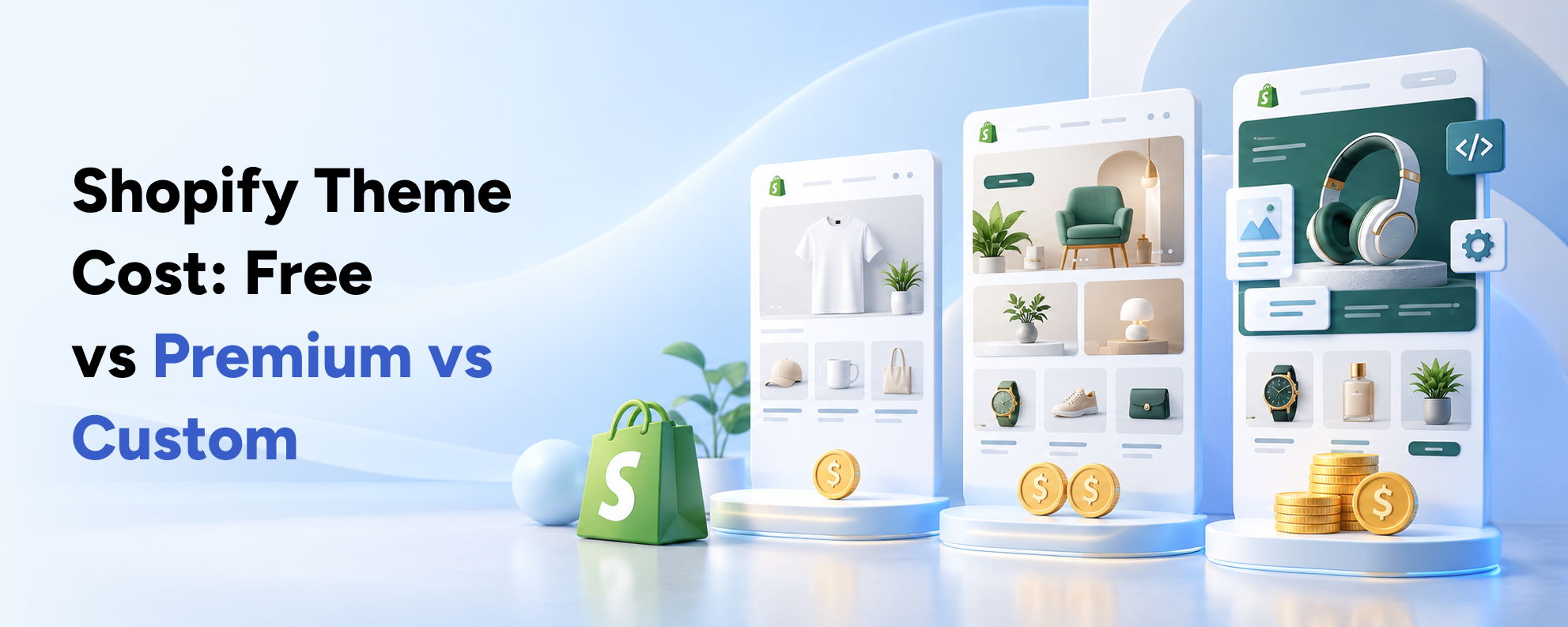
Shopify themes determine the main structure and appearance of your online store.
Businesses generally have three options.
Free Shopify Themes
Shopify offers free themes that can be configured using the built-in theme editor.
These are suitable for straightforward stores that do not require extensive customization.
A free theme can provide a practical starting point without a theme license cost.
However, business owners still need to account for configuration, content and design work.
Premium Shopify Themes
Paid themes typically offer additional layouts, merchandising features and design options.
Shopify's 2026 website cost guide places prebuilt theme pricing broadly between free and $400 or more.
Some premium themes can cost more depending on the current marketplace selection.
Visit the official Shopify Theme Store to review available themes and current prices.
Custom Shopify Themes
A custom theme is designed and developed around the brand's particular requirements.
This approach may be appropriate when a business needs distinctive layouts, reusable sections or features not adequately supported by an existing theme.
However, custom development requires a larger initial budget.
It may also create ongoing maintenance responsibilities as Shopify and third-party applications evolve.
Free vs Premium vs Custom Theme Comparison
| Feature | Free Theme | Premium Theme | Custom Theme |
|---|---|---|---|
| Initial Theme Cost | Free | Paid license | Custom development |
| Setup Speed | Usually faster | Usually faster | Depends on scope |
| Visual Flexibility | Standard | More built-in options | Tailored to requirements |
| Custom Functionality | May require development | May require development | Built into agreed scope |
| Maintenance | Theme updates and configuration | Theme updates and configuration | Custom code maintenance |
| Suitable For | Basic stores | Growing brands | Specialized ecommerce experiences |
For many businesses, a premium theme with thoughtful customization offers a practical balance between budget and design flexibility.
A custom theme is most useful when the business can clearly explain why standard options are insufficient.
Explore Basiltech's Shopify design services to understand how brand identity and conversion-focused UX influence storefront planning.
Shopify Payment Processing and Transaction Fees
Payment processing is one of the most frequently overlooked Shopify expenses.
Even after a website is built, payment providers charge fees for processing eligible transactions.
These are separate from the monthly Shopify subscription.
Shopify Payments
Shopify Payments is available to eligible merchants in supported countries.
Transaction rates depend on the merchant's plan, location, payment type and other conditions.
For example, Shopify's published US pricing for Basic displays online card rates starting at 2.9% plus $0.30 per transaction.
That figure should not be assumed to apply to every merchant or payment method.
Example: Payment Processing Cost
Imagine a US store processes 200 qualifying online card orders with an average value of $50.
Total order value:
200 × $50 = $10,000
Using a hypothetical rate of 2.9% plus $0.30 per order:
Percentage-based fees: $290
Fixed transaction fees: $60
Total estimated payment processing fees: $350
This example assumes all transactions qualify for the stated rate and excludes refunds, disputes, taxes and other potential charges.
What About Third-Party Payment Gateways?
Some merchants use external payment providers because of regional requirements or business preferences.
In those cases, both provider processing charges and applicable Shopify third-party transaction fees may apply.
Payment costs can materially affect businesses with high transaction volumes.
Before selecting a Shopify plan, compare the total payment processing expense rather than evaluating subscription fees alone.
Shopify App and Integration Costs
Shopify's App Store provides tools for extending store functionality.
These may support reviews, subscriptions, advanced filtering, shipping, email marketing and customer retention.
Some applications are free.
Others use monthly subscriptions, usage-based charges or transaction-based billing.
Common App Categories
| App Category | Business Purpose |
|---|---|
| Reviews | Collect and display genuine customer feedback |
| Email Marketing | Automate customer communication |
| Subscription Management | Support recurring orders |
| Product Bundles | Combine relevant products |
| Shipping | Manage delivery rules and fulfillment |
| Search and Filtering | Improve product discovery |
| Customer Support | Manage customer inquiries |
| Analytics | Extend reporting capabilities |
How Much Should You Budget for Apps?
An early-stage store may use mostly free applications.
A growing business might allocate $30–$150 per month to paid applications.
A more complex store could spend several hundred dollars or more each month.
These are illustrative planning allowances, not standardized app pricing.
Actual charges depend on the individual application, usage and order volume.
Avoid Paying for Features You Already Have
Shopify offers built-in functionality and first-party apps for several common requirements.
For example, Search & Discovery, Forms and Shopify Flow may reduce the need for certain third-party applications.
Review existing capabilities before purchasing additional software.
When Custom Integrations Make Sense
A custom integration can be appropriate when standard applications cannot reliably support the required business process.
For example, a retailer operating multiple warehouses may need specialized inventory synchronization.
Before choosing a custom solution, compare development, hosting, support and long-term maintenance costs with available alternatives.
Shopify Migration Cost in 2027
Migrating an existing ecommerce website can be more complex than launching a new store.
Businesses moving from WooCommerce, Wix, Magento or a custom platform should evaluate the full migration scope.
What Does Shopify Migration Include?
A migration may involve:
- Products and Collections
- Customer Records
- Order History
- Website Content
- Product Images
- SEO Metadata
- URL Redirects
- Shipping and Tax Configuration
- Third-Party Integrations
- Storefront Redesign
- Post-Migration Testing
Not every historical data type transfers automatically or in an identical format.
Compatibility should be checked before the project begins.
Why SEO Migration Matters
A website migration can change product URLs, collection structures and content paths.
If important URLs are removed without appropriate redirects, customers and search engines may encounter broken pages.
A migration plan should include a URL inventory, redirect mapping, metadata preservation and post-launch monitoring.
Even with careful implementation, no agency can guarantee that search rankings will remain unchanged.
How Much Does Shopify Migration Cost?
A small migration using compatible tools may require relatively limited development work.
A larger migration involving thousands of products, historical orders and custom functionality can require significantly more resources.
The migration cost should therefore be based on a detailed assessment rather than a fixed price per product.
Basiltech's Shopify migration services address platform transitions, technical requirements and SEO considerations.
Shopify Website Maintenance and Ongoing Expenses
Launching a Shopify store is not the final expense.
Businesses should plan for recurring operational costs.
Shopify manages core hosting and platform infrastructure, but merchants may still need assistance with storefront changes, applications, integrations and marketing.
Common Ongoing Costs
| Expense | Billing Pattern |
|---|---|
| Shopify Subscription | Monthly or contracted term |
| Domain Renewal | Usually annual |
| Paid Applications | Monthly, annual or usage-based |
| Payment Processing | Per qualifying transaction |
| Storefront Maintenance | As required or under an agreement |
| Technical Support | Project-based or ongoing |
| SEO and Content Marketing | Ongoing if outsourced |
| Google and Meta Advertising | Based on campaign spend |
| Email Marketing | Subscription or usage-based |
| Product Photography | As needed |
Does Shopify Include Hosting?
Yes. Shopify's standard online store plans include managed hosting and an SSL/TLS certificate.
You generally do not need to purchase separate basic web hosting for a conventional Shopify storefront.
However, specialized headless architectures, external applications or supporting services may create additional infrastructure costs.
Why Maintenance Matters
Store requirements can change as the business introduces new products, markets or applications.
Ongoing technical work may include theme improvements, integration updates and conversion testing.
For an established ecommerce business, maintenance and optimization can be more valuable than repeatedly redesigning the entire website.
Realistic Shopify Website Budget Examples
To understand the actual investment, consider three illustrative business scenarios.
All amounts are in USD.
These examples are budgeting exercises, not Basiltech quotations or guaranteed provider rates.
Example 1: A Small Business Launching Its First Shopify Store
Imagine an entrepreneur launching a store with 20 products.
The business uses Shopify Basic, a free theme and the built-in ecommerce tools.
The owner configures the store independently.
| Expense | Estimated First-Year Cost |
|---|---|
| Shopify Basic — Annual Billing | $348 |
| Domain Registration | $20 |
| Free Shopify Theme | $0 |
| DIY Setup Labor | $0 cash expense |
| Optional Paid Apps | $0 |
| Total | $368 |
This is a minimal platform-and-domain budget.
It does not include the owner's time, inventory, photography, payment fees, advertising or other business costs.
For a small product catalogue and simple requirements, a DIY Shopify store can be a reasonable starting point.
Example 2: A Growing Beauty Brand
Consider a beauty company launching a professionally customized Shopify store.
The business requires improved product pages, collection filtering, mobile UX and email marketing integrations.
The following is an illustrative one-year budget.
| Expense | Estimated First-Year Cost |
|---|---|
| Shopify Grow — Annual Billing | $948 |
| Domain | $20 |
| Premium Theme Allowance | $400 |
| Professional Design and Development | $8,000 |
| Paid Apps — $100/Month | $1,200 |
| Maintenance — $200/Month | $2,400 |
| Total | $12,968 |
The example assumes one-time development, theme and domain expenses alongside recurring subscriptions and maintenance.
Advertising, payment fees, inventory and product content production are excluded.
This type of budget gives the business room for a more tailored shopping experience without necessarily requiring Shopify Plus.
Example 3: An Established Ecommerce Brand
Imagine an established retailer with advanced product requirements and several integrations.
The business needs custom theme development, operational integrations and ongoing optimization.
| Expense | Estimated First-Year Cost |
|---|---|
| Shopify Advanced — Annual Billing | $3,588 |
| Domain | $30 |
| Custom Design and Development | $25,000 |
| Integration Implementation | $8,000 |
| Paid Apps — $250/Month | $3,000 |
| Maintenance — $600/Month | $7,200 |
| Total | $46,818 |
This budget assumes that custom design and integration development are separate scopes with no overlapping charges.
Real quotations should define these boundaries carefully.
It also excludes payment processing, advertising and other operating expenses.
What These Examples Reveal
The subscription is often not the largest expense in a professionally developed Shopify website.
Design, development, integrations and ongoing support can account for a substantially larger portion of the investment.
For this reason, businesses should evaluate the complete cost of ownership rather than focusing exclusively on Shopify's monthly price.
Shopify vs WooCommerce: Which Costs More?
Many businesses compare Shopify with WooCommerce when planning an ecommerce launch.
The platforms use different approaches to pricing and infrastructure.
Shopify operates as a managed ecommerce platform with recurring subscription fees.
WooCommerce is an ecommerce plugin for WordPress, but businesses generally arrange hosting, maintenance and additional functionality separately.
Shopify vs WooCommerce Cost Comparison
| Cost Factor | Shopify | WooCommerce |
|---|---|---|
| Ecommerce Software | Paid subscription | Core plugin is free |
| Basic Hosting | Included | Usually purchased separately |
| SSL | Included for standard storefront | Depends on hosting provider |
| Themes | Free and paid | Free and paid |
| Plugins or Apps | Free and paid | Free and paid |
| Technical Maintenance | Core platform managed by Shopify | WordPress and plugin maintenance required |
| Custom Development | Additional cost | Additional cost |
| Payment Processing | Provider and plan dependent | Gateway dependent |
| Security Responsibility | Managed platform with merchant obligations | More infrastructure responsibility for store owner |
| Scaling Costs | Plan, app and integration dependent | Hosting, development and plugin dependent |
Is WooCommerce Cheaper?
WooCommerce may provide a lower software licensing cost because the core plugin is free.
However, hosting, premium extensions, technical support and ongoing maintenance can increase the total expense.
Shopify provides more infrastructure within its subscription but may require paid apps or plan upgrades for certain features.
Neither platform is automatically cheaper in every situation.
The right comparison should examine a three-year or longer ownership period, including maintenance, integrations and internal staffing.
For a more detailed comparison, read Shopify vs WooCommerce: Which Is Better for Your Business?.
How Will Shopify Website Costs Change in 2027?
Several developments could affect ecommerce website budgets in 2027.
However, these are potential influences rather than confirmed price changes.
1. AI Shopping and Product Discovery
Shopify is expanding its infrastructure for AI-assisted shopping and product discovery.
Businesses may increasingly prioritize accurate product data and integrations with supported AI shopping channels.
Some capabilities may be included in platform subscriptions.
Other specialized requirements could involve additional technical work.
Businesses should evaluate AI readiness based on practical customer and product needs.
2. More Advanced Personalization
Ecommerce brands may invest in personalized product discovery, customer segments and tailored marketing.
The cost will depend on the complexity of the personalization strategy and the tools required.
Not every store needs expensive personalization software.
3. Increased Focus on Conversion Optimization
Businesses investing in advertising want to make better use of their traffic.
This can increase demand for UX improvements, analytics, checkout optimization and ongoing testing.
Such services create additional costs but may provide measurable commercial value when applied to genuine problems.
4. Greater Integration Complexity
As retailers connect more systems, integration and data management may consume a larger share of development budgets.
This is especially relevant for businesses with wholesale operations, international markets or complex inventory processes.
5. AI-Assisted Development Tools
AI tools may help developers and business owners complete certain tasks more efficiently.
For example, they can support content drafting, code assistance and repetitive workflows.
However, they do not eliminate the need for requirements planning, security review, quality assurance or professional implementation.
A lower cost for one task does not guarantee a lower total project price.
How to Reduce Shopify Development Costs
A smaller budget does not necessarily mean accepting a poor shopping experience.
Businesses can reduce unnecessary spending through careful planning.
1. Start With Essential Functionality
Identify the features customers need to complete a purchase.
Prioritize product discovery, accurate information, checkout and mobile usability.
Consider introducing advanced functionality after the store has demonstrated a clear business need.
2. Use an Appropriate Shopify Theme
A free or premium theme may provide most of the functionality a new store requires.
Avoid commissioning custom development solely to reproduce a standard theme feature.
3. Audit App Requirements
Check whether Shopify already provides the functionality you need.
Using fewer, carefully selected applications can reduce ongoing costs and maintenance complexity.
4. Prepare Product Information Early
Accurate product titles, descriptions, images, variants and categories reduce unnecessary back-and-forth during development.
A clean product catalogue also makes migration and merchandising easier.
5. Define Project Requirements Clearly
Unclear scope can lead to repeated design changes and additional development.
Document the required templates, features and integrations before requesting a detailed quotation.
6. Plan for Marketing Separately
Website development and customer acquisition are different investments.
Allocate realistic budgets for SEO, paid advertising, content and other marketing activities.
A well-built Shopify store still needs a strategy for attracting relevant customers.
7. Prioritize Conversion Improvements
If your business already receives traffic, improving product pages or checkout usability may be more valuable than immediately rebuilding the entire website.
DIY vs Freelancer vs Shopify Development Agency
Businesses generally have three approaches to building a Shopify website.
Each involves different costs, responsibilities and levels of support.
DIY Shopify Development
A do-it-yourself approach is suitable for simple stores and business owners comfortable working with Shopify's tools.
It reduces external development fees.
However, it requires time for setup, content preparation, testing and troubleshooting.
Hiring a Shopify Freelancer
A freelancer can help with defined tasks such as theme customization, product page improvements or integrations.
This may be cost-effective for small projects with clear requirements.
However, larger projects can require multiple skills across design, development, testing and marketing.
Hiring a Shopify Development Agency
An agency may be suitable when a business needs coordinated design, development, technical strategy and ongoing optimization.
A structured project team can help manage requirements, integrations and launch activities.
However, agencies differ in experience, scope and pricing.
Businesses should compare deliverables, technical expertise and contractual terms rather than choosing solely on brand reputation.
Comparison Table
| Factor | DIY | Freelancer | Agency |
|---|---|---|---|
| Upfront External Cost | Generally lowest | Scope dependent | Scope dependent |
| Technical Responsibility | Business owner | Shared | Defined through agreement |
| Design Resources | Built-in tools | Depends on freelancer | Can include dedicated designers |
| Custom Development | Limited without expertise | Available | Available |
| Project Management | Business owner | Often shared | Usually structured |
| Ongoing Support | Self-managed | By agreement | By agreement |
| Best Fit | Simple stores | Defined technical tasks | Multi-disciplinary projects |
Expert Insight: Why Customization Matters
John Hart, Ecommerce Manager at Peepers, highlighted the value of Shopify customization in a Shopify-published ecommerce development guide:
“The ability to customize with Shopify really allows us to push it to the limit.”
His observation illustrates why businesses with specialized requirements may invest in custom development rather than rely entirely on default storefront features.
However, customization should always address a genuine business need.
What Should Be Included in a Shopify Development Quote?
Before selecting a Shopify developer or agency, request a clear breakdown of services.
A professional proposal should explain what is included, what is excluded and which responsibilities belong to the client.
Essential Items to Review
- Number and Type of Website Templates
- Design and UI/UX Deliverables
- Shopify Theme Selection
- Custom Development Requirements
- Product and Content Migration
- Application Installation
- Third-Party Integrations
- Payment and Shipping Configuration
- Technical SEO Requirements
- Mobile Optimization
- Quality Assurance and Testing
- Revision and Approval Process
- Project Timeline and Milestones
- Support and Maintenance Terms
- Third-Party Software Costs
- Final Handover and Ownership Arrangements
Ask About Ongoing Expenses
An initial development quotation may not include paid applications, Shopify subscriptions or advertising budgets.
Request separate estimates for recurring expenses.
This makes it easier to compare proposals accurately.
Understand the Difference Between Design and Development
Website design determines how the store looks and how customers interact with it.
Development turns those designs into functioning Shopify templates, integrations and purchasing experiences.
Some projects require both services.
Others only need improvements to an existing storefront.
Understanding this difference helps prevent businesses from paying for work they do not need.
Why a Discovery Process Matters
A detailed quotation is more reliable when an agency understands the products, customer journey and technical requirements.
For example, a simple subscription store may have very different needs from a multi-market wholesale retailer.
At Basiltech Solutions, our Shopify design, development and ecommerce growth services are structured around the business requirements of each project.
The objective is to recommend an appropriate solution rather than assume that every store requires an expensive custom build.
Frequently Asked Questions
How much does a basic Shopify website cost in 2027?
A basic Shopify store can be launched with a platform subscription, domain and free theme. Based on published 2026 US pricing, Basic costs $29 per month when billed annually. That equals $348 annually, excluding the domain and other expenses. Actual 2027 pricing may change. Professional setup, custom design and marketing would increase the budget.
How much does it cost to hire someone to build a Shopify website?
Professional development costs depend on scope. A relatively simple store setup may require a smaller investment than a custom website with multiple templates and integrations. For preliminary planning, businesses might consider $1,500–$5,000 for a basic setup and substantially more for custom projects. These are illustrative estimates, not guaranteed market rates. A detailed quotation is needed for accurate pricing.
Is Shopify free to use?
Shopify offers trials and promotional subscription offers, but a conventional live Shopify online store generally requires a paid plan after the applicable promotional period. Free themes and some first-party tools are available. Domain registration, payment processing and other business expenses may still apply.
Does Shopify charge a monthly fee?
Yes. Shopify offers subscription plans with monthly or annual billing arrangements, depending on the plan. As of 2026, US Basic pricing is $39 with monthly billing or $29 per month with annual billing. Grow and Advanced have higher rates. Shopify Plus operates under separate contractual terms.
Does Shopify include website hosting?
Yes. Shopify includes managed hosting and an SSL/TLS certificate with its standard online store plans. Businesses generally do not need to purchase separate conventional hosting for a normal Shopify storefront. Specialized external applications or headless storefront architectures may introduce additional infrastructure expenses.
How much does a custom Shopify website cost?
A custom Shopify website can require an investment ranging from several thousand dollars to substantially more for complex projects. Costs depend on design requirements, custom features, integrations, catalogue structure and testing. An enterprise project may require significantly greater expenditure. The best way to determine cost is through a detailed technical assessment.
Is Shopify Plus worth the cost?
Shopify Plus can be appropriate for businesses requiring enterprise capabilities, advanced B2B functionality, specialized checkout customization or complex operations. However, businesses should compare its features and contractual costs against their actual requirements. Upgrading solely because the company expects higher sales may not be financially justified.
How much do Shopify apps cost per month?
Some Shopify applications are free, while others charge monthly, annual or usage-based fees. A small store may operate with minimal paid apps. More complex businesses can spend hundreds of dollars or more monthly. Review the Shopify App Store pricing for the specific applications you need rather than relying on a universal estimate.
How much does it cost to migrate from WooCommerce to Shopify?
Migration costs depend on product volume, order history, data structures, content, integrations and SEO requirements. A straightforward migration may be relatively affordable, while complex migrations require more development and testing. Businesses should request an audit of their existing store before approving a migration budget.
Is Shopify cheaper than WooCommerce?
Neither platform is universally cheaper. Shopify charges a subscription that includes managed hosting and core ecommerce infrastructure. WooCommerce's core plugin is free, but hosting, extensions, maintenance and technical support can add expenses. A meaningful comparison should include total ownership cost rather than software licensing alone.
Does a more expensive Shopify website generate more sales?
Not necessarily. Higher development expenditure may provide additional functionality or a more customized experience, but it does not guarantee sales. Revenue depends on product demand, pricing, customer acquisition, trust and website usability. Businesses should invest in features that address measurable customer and operational needs.
Should I budget for SEO and digital marketing separately?
Yes. Website development creates the technical and visual foundation for an ecommerce business, while SEO and digital marketing help attract relevant customers. Some launch packages include basic SEO configuration, but ongoing content creation, advertising and optimization are usually separate activities. Confirm exactly what is included in your project agreement.